By Răzvan Vergu, sales trainer, Salescool co-founder · Published · Updated
The price objection, or how to argue about price for something nobody wants
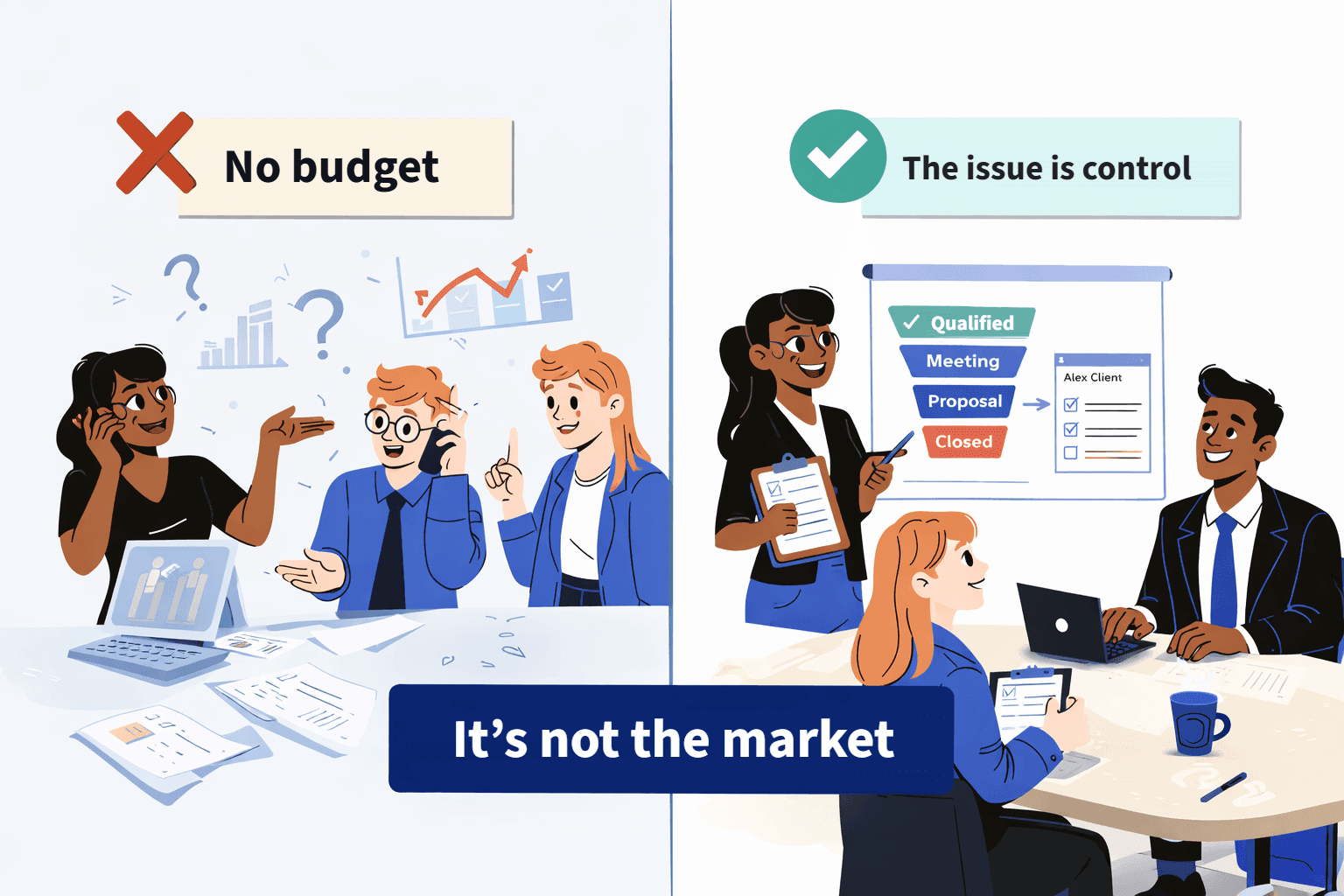
Let us demolish a comfortable myth in the first sentence. When a client tells you “it is too expensive”, most of the time (an observation from the training room, not a statistic) they are not talking about money. They are telling you, politely, that you gave them no reason to pay.
And instead of hearing that, you rush to sign up for a negotiation course, convinced you are missing a magic technique for handling the price objection. You are not missing a technique. You are missing the value you should have built three steps earlier. Price becomes a problem exactly when value does not exist. The rest is noise you call “negotiation”.
Handling the price objection is pointless if you sell a commodity nobody wants
Let us be brutal from the start. If the only thing left to discuss with the client is the number on the quote, congratulations: you turned a solution into a commodity. And commodities have one relevant question, how much does it cost. And one winner, the cheapest.
No negotiation course in the world gets you out of that trap, because it is not a negotiation trap. It is a positioning trap. You arrived at the table without value, and now you are trying to invent it out of anchors and shrinking concessions. Too late.
The research summarised by The Expert CFO says it without softening: most “price concerns” are actually hidden value problems, not real budget limits. Which means the objection is not about the client’s wallet. It is about the gap you left in their mind.
The price objection and the great illusion that “the client is price sensitive”
“My client is very price sensitive, that is why I argue over every leu.”
Adorable. Except that, most of the time, the only person obsessed with price in the whole conversation is you.
Vistage puts it brilliantly: pressure on price is a symptom that the salesperson has not demonstrated value, and price matters most exactly when the salesperson believes price matters most. Translated: the client senses your insecurity. If you flinch at the number, so will they. If you think you are expensive, they will think so too.
A negotiation course that actually matters does not teach you to defend a price you do not believe in more skilfully. It teaches you to build value beforehand, so price is no longer the main subject. The rest is group therapy for insecure salespeople.
The price objection: “too expensive” means “you did not convince me”
Let us translate from client language into reality. “It is over our budget” usually means “you did not show me what I gain”. “The competition is cheaper” means “you gave me no reason not to buy the cheapest”. “I will think about it” means “you did not make me care”.
SBI Growth nails it: many price objections appear not because of the actual price but because of how you sell, talking too much about features, not listening, not asking enough discovery questions. And features have no value in themselves. They gain value only when they solve a need that matters to the buyer. If the buyer does not see the link, their reaction is predictable: a price objection.
So before you sign up for your third negotiation course this year, ask yourself honestly: did I build value, or did I just recite a feature sheet? Because if the answer is the second, your negotiation was lost before you said the first number.
The price objection: value is built early, not invented at the end
Here is what nobody tells you at the spectacular negotiation seminar. Value is not something you pull out of your pocket when the objection appears. It is something you build methodically, from the first contact, through discovery, through questions, by tying the solution to a measurable outcome.
VanillaSoft, quoting sales experts, is clear: the only way to overcome price objections is to emphasise value throughout the process, not just at the end. Value is defined by the buyer, not by the seller, and if you skipped discovery, you cannot know what value means to them. So you cannot build it. So you are left with price. Alone. On the ground where you always lose.
A serious negotiation course does not train you for the last round. It teaches you that the fight over price is only the invoice for the value you never built.
The price objection: if you argue about price, you already lost the value conversation
From what we see in the teams we work with, results come from execution, discipline and a process that builds value at every step, not from a collection of tricks pulled out in desperation at the end.
The brutal truth is that arguing over price is not the peak of sales mastery. It is the signal that you missed everything that mattered before. A good salesperson rarely negotiates hard on price, because they rarely let the conversation get there without value built. A weak salesperson argues over every leu and then calls it “tough negotiation”.
Salescool courses: value first, then price
At Salescool we do not teach tricks for saving a lost deal. We work on exactly the part the price fight hides: how you build value from the first contact, how you run a real discovery, how you tie the solution to an outcome that matters, through role play and real scenarios, until price becomes a formality rather than a battlefield. If the conversation gets stuck on negotiating price and terms, that is exactly what you practise in Negotiation Playbook, the one-day negotiation course.
Because a negotiation course that only teaches you to defend the price, without teaching you to build value, prepares you for a battle you should never have fought.
If you got this far and still believe the problem is the price, you probably need a course that teaches you to argue better. If you understood that price becomes a problem only when value is missing, then we speak the same language. See the Salescool programmes and find out how we turn theory into measurable behaviour in the field.
If you want to build value early rather than invent it at the price stage, take a look at the advanced sales course or the closing mentoring programme.
Next: If you want to practise this with your team, the right programme is From NO to GO, the objection handling course. Every question about sales training, in one place: The complete guide to sales training courses in Romania.