By Răzvan Vergu, sales trainer, Salescool co-founder · Published · Updated
Negotiation mistakes, or why your salesperson negotiates for the client, not for you
There is a scene every manager sees monthly without understanding what they are looking at. The salesperson walks in triumphant: “I closed it! I just had to come down a little on price.”
A little. Always just a little. And strangely, that “little” shows up right at the end of the month, exactly when the commission threshold is near.
Here is the uncomfortable truth no seminar brochure prints: you can send your whole team to the most expensive negotiation courses in the country, but if your commission plan pays the salesperson to close at any cost, you have already trained them to lose the negotiation. Commissions sabotage exactly what you are trying to build.
Negotiation mistakes: training the person is pointless if you pay them to fold
Let us think like a rational salesperson for a second. They are paid on volume. Their commission depends on how much they sign, not on how well they defend the price. What will a normal person do in that situation?
They will give on price. Fast. Every time.
Not because they are weak. Because it is logical. You built a system where a 15% discount costs them almost nothing in commission but gets them the signature today rather than in two weeks. The best negotiation courses in the world cannot compete with a payslip that tells them daily: cut the price, collect, move on.
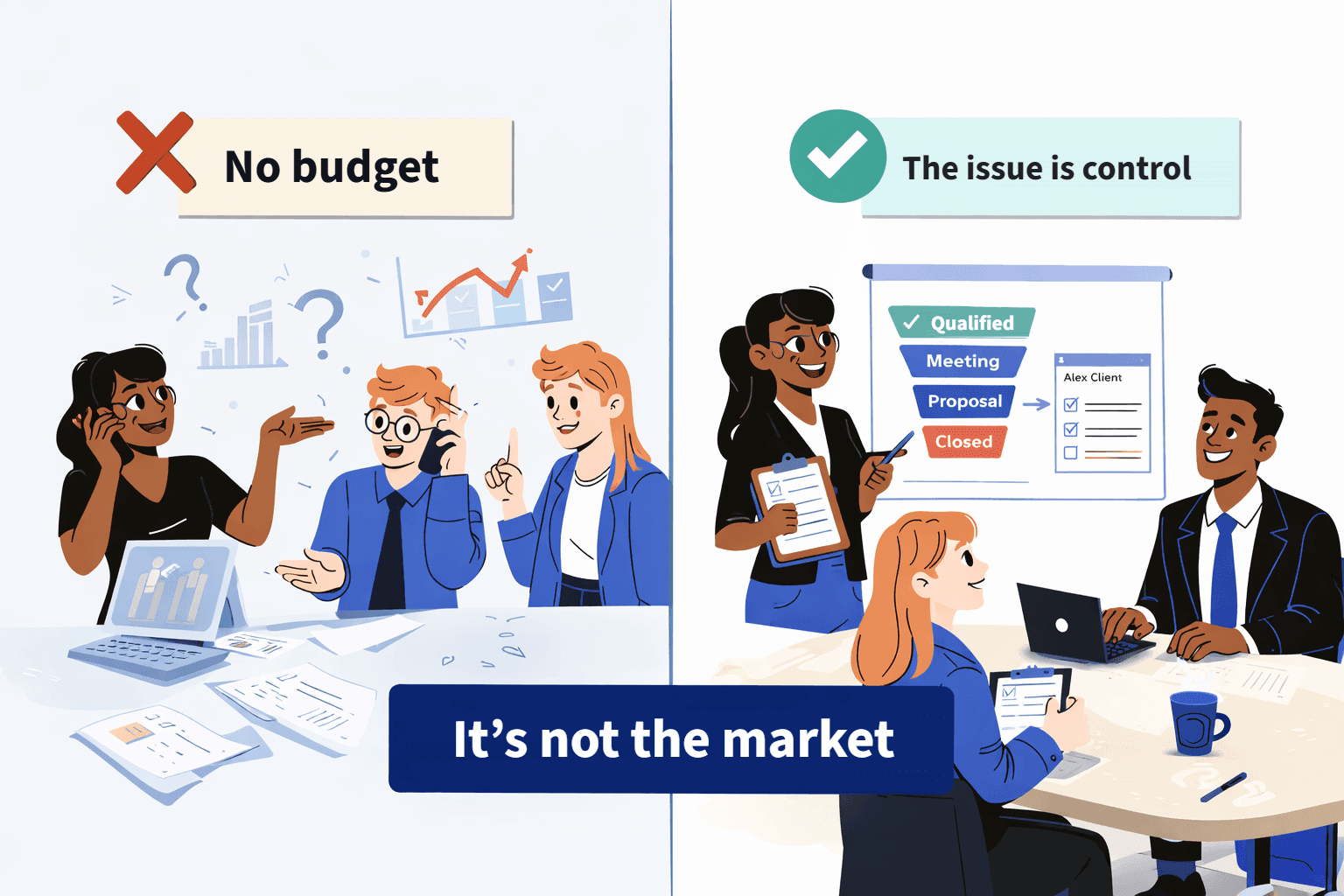
The analyses from Xactly say it plainly: when plans reward revenue at any cost, salespeople discount to cover their gaps, and that is how margin erosion creeps in. Not because of the market. Because of your own pay system.
Negotiation mistakes: a volume commission is a course in capitulation
Let us be honest about one thing. Every commission structure teaches a lesson. The only question is what it teaches.
A volume commission teaches capitulation. It tells salespeople that only closing matters, not how you close. So salespeople do exactly that. Data from Fullcast confirms the mechanism: reps offer heavy discounts to push deals toward signature, which erodes margins and trains buyers to wait for concessions. And here is the number that should scare any manager, cited by Fullcast from Gartner: nearly 80% of organisations believe their commission plans fail to drive company objectives.
Translated: eight out of ten companies actively pay for the wrong behaviour and then buy negotiation courses to fix it. It is like pouring water into a leaking bucket and blaming the water.
Negotiation mistakes and the illusion that “the problem is the people”
“My people do not know how to negotiate, that is why I give on price.”
Nice. But before you blame them, look at what you pay them to do.
If you measure and reward revenue only, the salesperson will follow the plan, not the strategy. Research from CaptivateIQ shows exactly that: when incentives are misaligned with company objectives, reps follow the plan instead of the strategy, even when that means chasing low value deals and caving on price. It is not a character problem. It is a design problem.
You can run the best negotiation courses possible, but if at the end of the month the system still rewards whoever cut the price to hit their bonus, guess which behaviour you will see next time. Exactly the same one.
Negotiation mistakes: the answer is not only technique, it is alignment
Here is what nobody tells you at the negotiation seminar. The technique and the pay system have to say the same thing. Otherwise the system always wins. Always. Money speaks louder than slides.
The solution is not only to teach your people to defend the price. It is to stop paying them to abandon it. That means, for instance, commission tied to margin rather than volume alone, exactly the mechanism described by NetCommissions, where gross margin plans are designed precisely to encourage salespeople to defend value and to limit discounting as a selling tool. When the discount hurts the salesperson’s own commission, they suddenly become an excellent negotiator. What a coincidence.
And the stakes are enormous. A McKinsey analysis (The power of pricing, McKinsey Quarterly, 2003) shows that a 1% price increase, with volumes held steady, lifts operating profit by about 8%. Which means every “little” given on price is not little. It is a direct hole in profit.
Negotiation mistakes: fix the system first, then train the person
From what we see in the teams we work with, results come from alignment, measurement and execution, not from an injection of motivation or a training day layered on top of a system pulling in the opposite direction.
So before you buy more negotiation courses, ask yourself one simple question, the one compensation specialists recommend: “If a rational salesperson followed my commission plan perfectly, would I get the results I want?” If the answer is no, the problem is not your people. It is what you pay them to do.
Salescool courses: negotiation that holds, not tricks that evaporate
At Salescool we do not teach techniques divorced from field reality. We work on negotiation as a behaviour that holds under pressure, including the pressure to close fast.
Through role play and real scenarios, we train salespeople to defend value, to ask for reciprocity for any concession, and to stop confusing “closed today” with “closed well”. Because negotiation courses that ignore what your system pays you to do are just pretty theory delivered in a room.
If you got this far and still believe the problem is only a lack of technique, you probably need another course. If you understood that a badly designed commission system sabotages any negotiation, then we speak the same language. See the Salescool programmes and find out how we turn theory into measurable behaviour in the field.
If you want negotiation that holds rather than tricks that evaporate, take a look at the advanced sales course or the closing mentoring programme.
Next: If you want to practise this with your team, the right programme is Negotiation Playbook, the negotiation course. Every question about sales training, in one place: The complete guide to sales training courses in Romania.