By Răzvan Vergu, sales trainer, Salescool co-founder · Published · Updated
The pipeline does not lie. It just shows you what you do not want to see.
The pipeline is the most honest place in sales. It has no ego. No “feeling”. No optimism. It has numbers, stages and values. That is all.
And that is exactly why it makes people uncomfortable.
When reality looks weak, the natural reflex is not to correct it. It is to dress it up. The lie does not look like a lie. It looks like “confidence”.
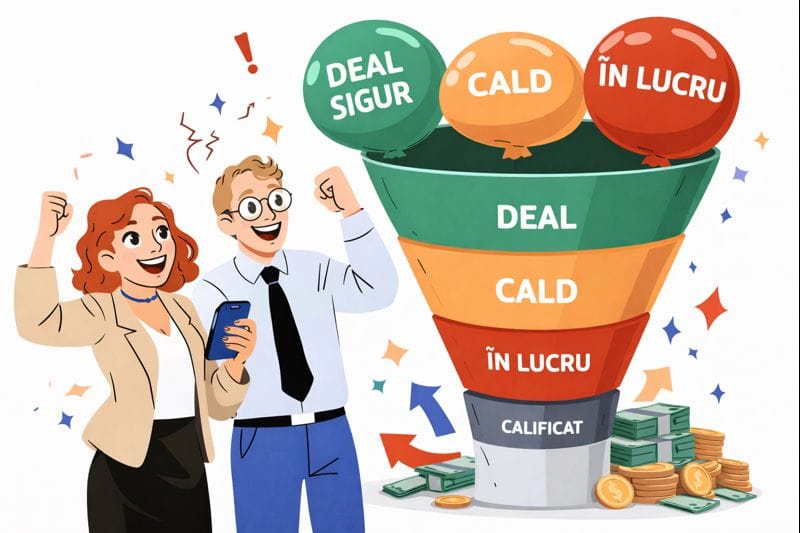
A deal that is “almost certain” with no clear decision maker.
A “warm” one with no confirmed budget.
An “in progress” with no next step agreed.
A proposal sent three weeks ago with no reaction, still sitting there optimistically in the system.
On screen, everything looks active. In the field, nothing moves forward. And the gap between perception and execution is exactly the gap between illusion and performance.
When the numbers look good but the decisions are wrong
An inflated pipeline produces an inflated forecast. Then management makes decisions based on an optimistic story: it sets higher targets, hits the accelerator, raises the pressure. Not because reality supports it, but because the numbers look convincing on a dashboard.
When the month closes below estimates, urgency arrives. Things get “recovered” at the end. Prices get cut. Decisions get forced. Margins get compressed. Not because it is strategic, but because the projection had to be confirmed.
The problem is not only the opportunities lost. The problem is the loss of control. When you lead on cosmetic data, you react emotionally. And emotional reaction in sales almost always costs: in margin, in credibility and in the team’s trust.
Over time a dangerous pattern sets in: salespeople who are always busy and always “close”, managers who discuss amounts rather than criteria, meetings where the talk is about optimism rather than concrete evidence.
The culture that appears when dressing things up becomes normal
If data can be adjusted without consequences, the team quickly learns the wrong lesson: reporting is internal marketing. What matters is that it looks good, not that it is real.
Stages become elastic. “Qualified” means something different to everyone. Probabilities are based on enthusiasm, not on actions validated by the client. Dead opportunities stay active simply because they pad the volume.
In these conditions, coaching becomes superficial. You can no longer identify where the process breaks. You can no longer correct systemically. Everything stays at the level of impressions and justifications.
And impressions do not scale.
The simple truth is this: what you see reflects exactly the quality of your execution. If the system is full of “almost”, you have a process problem, not a market problem. If stages are stuck, you have a qualification problem, not an external context problem.
What serious sales training changes
Solid training does not teach you to fill in the CRM more neatly. It forces you to clean up reality and to treat the pipeline as a decision-making instrument.
In the Salescool courses, the emphasis falls on structure and clear criteria. What a qualified opportunity means gets defined. What conditions must be met to move from one stage to the next. What a next step validated by the client actually is. And, just as importantly, when a deal must be pulled out of the system without emotional attachment.
It sounds simple. It is not. Because it requires discipline and managerial accountability.
A clean system may look emptier at first. But the real work begins in exactly those gaps. That is where you see whether the problem sits in generation, in qualification or in negotiation. That is where you can intervene precisely rather than emotionally, and rebuild a healthy pipeline.
A realistic pipeline gives you predictability. Predictability gives you control. And control gives you strategic freedom.
In the end the conclusion stays clear: the system does not lie. It only reflects your commercial execution.
The distortion appears when you use it to look busy rather than to sell. And the difference between those two is the difference between chaos and performance that is scalable, sustained and profitable in the long run.
Next: If the problem is the process or sales management rather than people’s skills, see the fractional sales manager service. Every question about sales training, in one place: The complete guide to sales training courses in Romania.