By Răzvan Vergu, sales trainer, Salescool co-founder · Published · Updated
In short: B2B sales (business to business) means selling to other companies, not to individual consumers. It differs from B2C in three ways: more people decide, the decision takes longer, and companies buy on written criteria, not on impulse. And in B2B sales, most opportunities are not lost to competitors but inside your own process: a lead picked up too late, a proposal sent without qualification, a follow-up nobody did.
What B2B means
B2B stands for “business to business”: one company sells to another. Software for companies, industrial equipment, accounting services, raw materials for production, logistics, training for teams. The opposite is B2C, “business to consumer”, where a company sells directly to people: a phone, a jacket, a holiday, home insurance.
The same company can sell both ways. A clinic sells B2C to patients and B2B to companies that buy health plans for their employees. What changes is not the product, but who decides and how.
B2B and B2C sales, side by side
| B2B | B2C | |
|---|---|---|
| Who buys | A company, through its people | A person, for themselves or their family |
| How many decide | Usually several: the user, the one who pays, the one who approves | One or two |
| How long the decision takes | Weeks or months, sometimes over a year | Minutes, days, rarely weeks |
| Value of a sale | Higher, often with a contract and renewal | Lower, often a single transaction |
| What the decision rests on | Written criteria, budget, risk, measurable results | Price, trust, emotion, convenience |
| Relationship after the sale | Continues: implementation, support, expansion | Often ends at delivery |
| What the salesperson does | Builds a case the client defends internally | Convinces one person, usually in the same conversation |
What the B2B sales process looks like, stage by stage
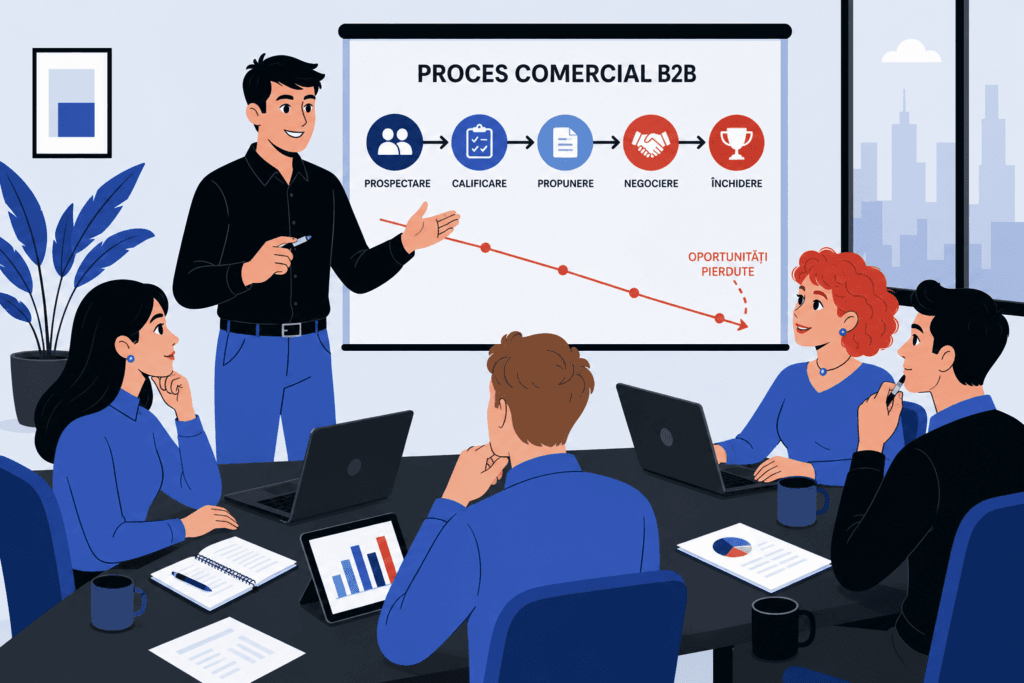
- Prospecting. You find the companies that have the problem you solve and reach the right person. On the phone side: why the phone never betrayed you.
- Qualification and discovery. You find out whether there is a real problem, what it costs, who decides and by when. Without this step, your proposal is just a price.
- The proposal. Tied directly to the cost of the problem you uncovered, and presented, not just emailed.
- Negotiation. You negotiate terms, not just price, and every concession gets something in return.
- Closing. The signature, with the client’s internal steps known in advance. How to tell whether you close well: what a good B2B closing rate is.
- Implementation and expansion. In B2B, the sale continues after the contract: a satisfied client buys again and refers others.
Each stage needs a clear criterion for moving to the next. What a controlled process looks like: a B2B sales process is not complex, it is just uncontrolled.
Competitors do not ruin your pipeline. Your process does.
In many B2B companies, competition is treated like a three-headed monster. Competitors’ prices, offers and promotions are tracked obsessively, and in every meeting someone says: “We lost because they were cheaper.”
Take a classic situation. A lead comes in. There are no qualification criteria. Nobody knows who owns it. The client gets a reply after three days, the proposal goes out four days later, and follow-up happens “when someone remembers”. Two weeks later comes the verdict: “The competition beat us.”
They did not. We lost before we ever really competed. A study by Vantage Point Performance and the Sales Management Association of 62 B2B companies, published in Harvard Business Review (Companies with a Formal Sales Process Generate More Revenue, 2015), found an 18% difference in revenue growth between companies with a formal sales process and those without one.
Talent does not make up for chaos
Many B2B teams have a hero salesperson: knows the clients, knows the market, saves quarters. The problem starts when they leave. Then the company discovers it never had a process, it had one very good person carrying everything.
A healthy sales process works even when the team’s star is on holiday, in training or at a competitor. Stories about the contract closed over coffee cannot be repeated on demand. Processes can.
What a good B2B salesperson does
- Asks questions before presenting and finds out what the client’s problem costs.
- Finds out who decides, who influences and how a purchase gets approved.
- Builds the material their champion inside the client company can use in a meeting they will not attend.
- Sets the next step, with a date, at every meeting.
- Keeps the pipeline up to date, so decisions are made on data, not impressions.
How we work on B2B sales at Salescool
For experienced salespeople, Sales Accelerator is our B2B sales course: two days of role-play on situations from the team’s own industry, with mentoring after the course. When the problem is not the people but the process, a course will not help; there we work under directordevanzari.ro, with a fractional sales director.
Further reading: To find where your opportunities are lost: how to audit your sales process, in four steps. Every question about sales courses, in one place: Complete Guide: Sales Training Courses in Romania.
Frequently asked questions
What does B2B mean?
“Business to business”: one company sells products or services to another. B2B sales are all sales in which the client is a company, not an individual.
What is the difference between B2B and B2C?
In B2B a company buys, several people decide, the decision takes longer and rests on written criteria. In B2C a person buys for themselves, usually quickly and on more personal criteria: price, trust, convenience.
What are B2B services?
Services companies buy from other companies: accounting, legal, IT, marketing, recruitment, logistics, cleaning, employee training. You recognise them by the fact that a company pays for them, for its own needs.
How long does a B2B sale take?
From a few weeks for small purchases with a single decision-maker to more than a year for large contracts, with tenders or several departments involved. The more people there are to convince, the longer it takes.
What does a B2B sales representative do?
Finds companies that need what they sell, qualifies opportunities, finds out who decides, builds and presents the proposal, negotiates and looks after the client after signing. The difference from B2C selling is that they work with several people in the same company, over a longer cycle.